

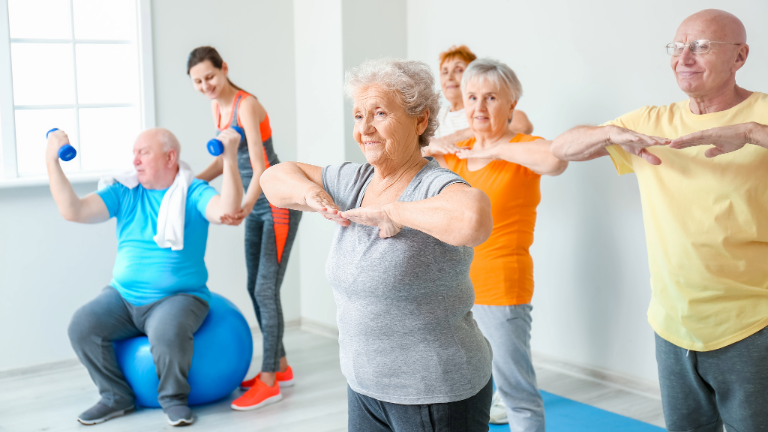
As you may know, before law school, after I landed in Philadelphia, I made my living as a personal fitness trainer. My career in fitness began many years earlier – until my freshman year in college, I never really exercised. That all changed when a girl I was dating broke my heart. I was so despondent I couldn’t sleep, couldn’t eat. I just sat in my dorm room. One lonely afternoon, I did some pushups. Then some air squats Then some jumping jacks. That moment catalyzed my interest. The next summer, I became a certified personal trainer and worked in the field, sometimes full-time, sometimes part-time, until just before the pandemic.
It wasn’t just my passion for fitness; it was my passion for the relationships. My clients became like family. I was invited to weddings, vacations, dinners, and birthdays. Even after leaving the industry, I remain close with some of those families. And I remain intertwined with fitness. I start every day of the week with exercise. It’s my religion – how I focus, clear my head, and maintain my health.
Just a few weeks ago, my brain suddenly clued into the connection between what I do and what I do: exercise and elder law. It’s easy to look at exercise as a task – burning calories here, building some muscle there; simply a chore to complete.
Just the same, it’s easy to look at elder care planning as something task-based: care coordination here, a power of attorney there, a carefully structured Medicaid spend-down. But beneath the legal and social frameworks lies something more ancient, more human — the question of how a body moves through the world as time reshapes it.
In this sense, the body becomes our first life care plan.
Its strengths and limitations quietly dictate the path ahead.
I recently had a conversation with a “fitness scholar” who sees fitness and exercise as physical and mental medicine that all cultures subscribe to in some way. Our discussion fascinated me and got me thinking, so I read more. Across cultures and eras, movement scholars have observed five fundamental patterns — the hinge, the bend, the push, the pull, and the twist. These aren’t just physical actions; they are symbols of how we participate in life, how we engage with gravity, how we rise, reach, adapt, and surrender.
Understanding these movements gives us insight not just into physical aging, but into the deeper story of how a person will experience their later years, and what forms of care they may eventually require.
Let’s explore them.
- The Hip Hinge (deadlift) — The Gesture of Humility and Return
The hip hinge is the motion of bowing, of lowering oneself toward the earth. It is the movement of:
- retrieving
- tending
- acknowledging gravity
In youth, we hinge without thought. As years pass, the descent becomes tentative — an unspoken negotiation with balance, pain, and fear of falling.
A diminishing hip hinge signals a shift in the dialogue between the body and the world. It tells us when everyday tasks begin requiring assistance, when rugs, laundry baskets, and dropped keys become hazards.
In elder care planning, the fading hinge is the body whispering:
“It may soon be time for help.”
- The Knee Bend (squat) — The Ritual of Rising
Squatting — bending the knees to lower and lift the body — is one of the oldest human rituals. It is the movement of:
- standing up
- sitting down
- returning to presence
More so than driving or even walking, the ability to rise without assistance is perhaps the clearest marker of independence. Losing it can feel like losing an invisible helium balloon that grants us ease of movement.
Where once there was fluidity, now there is hesitation, then reliance, then dependence.
In planning, the knee bend becomes a kind of prognosis:
When this movement falters, the future often brings caregivers, bathroom modifications, mobility supports, or the transition to new forms of living.
- The Push (pushups) — The Assertion of Will
The push is the motion of declaring oneself:
- pushing up from the floor
- pressing away from a chair
- resisting gravity
- saying “No, I’m free to make my choices, not those thrust upon me.”
In myth and metaphor, the push is the hero’s gesture — that moment when a person claims effort, space, or safety.
With aging, this capacity to push erodes. Doors feel heavier. A stumble becomes harder to correct. A fall possibly unrecoverable.
In elder care, fading pushing power is the body’s way of saying:
“My boundaries are becoming softer; I may require help to remain, or become, upright.”
- The Pull (rows) — The Act of Holding On
Pulling is the movement of:
- grasping
- anchoring
- drawing stability toward oneself
When older adults grip a railing, pull themselves from a bathtub, or hold a caregiver’s hand, you can see the symbolic meaning: a reaching both back to control and forward to connection.
Grip strength, in particular, has long been a poetic marker of vitality. Strong grip strength is linked to virility, vitality, and (clinically) longevity — a handshake that once conveyed vigor now becomes delicate.
For planners, diminishing pull strength signals practical needs: rails, aids, hardware, and assistance. But symbolically, it marks a shift to greater relational dependence — a leaning toward others.
- The Twist (no explanation needed) — The Dance of Orientation
Twisting is rotation, the movement of:
- looking over the shoulder
- turning toward a voice
- spiraling from one posture to another
- Pulling a car out of a parking spot, or onto a busy road
It is the most subtle of the five movements, and perhaps the most intimate. Twisting allows a person to stay connected to the world — to notice, respond, and participate.
As rotation diminishes, a person’s universe contracts. Driving becomes difficult. Reaching for a seatbelt becomes a chore. Even basic movement – doing laundry – becomes more static.
In elder care planning, the loss of twist often foretells a narrowing of independence — a body becoming more linear, more reliant on external structure.
The Deeper Lesson: Movement as Destiny
These five patterns are more than biomechanics — they are the elemental ways we negotiate life itself. When they weaken, it becomes a sign that a person’s future care needs are taking shape.
In this view, elder care planning is not merely legal work.
It is a response to the quiet messages the body sends as it changes.
The hinge says: “Prepare.”
The bend says: “Support me.”
The push says: “I’m still in control.”
The pull says: “Stay close.”
And the twist says: “Help me see what I cannot.”
Aging, Seen Through a Different Lens
If we listen carefully and feel thoughtfully, movement becomes an oracle — revealing when someone may thrive at home, when they may need help, when safety becomes paramount, and when legal and financial protections must be put in place.
Elder law is the art of translating these human signals into structure and security.
It is not just planning for decline.
It is honoring the movements a person can still make — and ensuring they are supported, protected, and dignified as long as possible.
I’m grateful for my past life as a fitness professional. I’m much more grateful for my continued ability to bend, hinge, push, pull, and twist – both literally and metaphorically. I’m equally thankful to have found a profession that allows me to use a different kind of strength: one built on advocacy and patience, providing clarity and tranquility for those facing the challenges of aging.
